A 2026 survey of 1,500 business managers and company owners on hiring, background screening, and compliance.
Executive Summary
Hiring has changed shape over the past two years, and not in one direction. AI now shows up in close to a third of hiring processes. Candidate fraud has stopped being a rare occurrence and has become something most HR teams have dealt with firsthand. And background screening, once a routine box to check, has become an essential step in the hiring process. We surveyed 1,500 business managers and company owners across the U.S. to get a clearer picture of how hiring teams are actually handling all of this.
The numbers tell a mixed story. Only 31.6% of companies use AI at all in their hiring process today. Within that group, opinion is evenly split: some argue that AI is genuinely helpful, while others say not much has changed. Candidate fraud, however, is no longer considered hypothetical. 18.5% of employers we interviewed say they have directly encountered or suspected it, while 22.9% admit they may have unknowingly interviewed a proxy or deepfake candidate at some point. Perhaps the clearest data point in the entire survey was as follows: 80.9% of respondents believe identity verification should be a standard part of background screening, while 67.5% think it should belong in every hiring process – not only the high-risk ones.
Compliance is where the gap really shows up. 72.9% of employers say they are confident their process complies with the laws that apply to them, but only 40.4% actually have a documented adverse action process. 43.7% aren’t even sure whether one exists. There’s a significant difference between merely feeling compliant and actually being able to prove it, and this is one of the more critical findings in this report.
When it comes to picking a screening provider, accuracy beats price by nearly two to one (35.5% vs. 18.1%). U.S.-based support matters more than a lot of providers probably assume, too – 83.8% of employers indicated it is very or somewhat important, and 46.5% said they would pay more for it.
The rest of this report breaks down what 1,500 employers told us about AI, fraud, verification, compliance, and where their screening budgets are headed.
A Changing Workforce: The 2026 Hiring Landscape
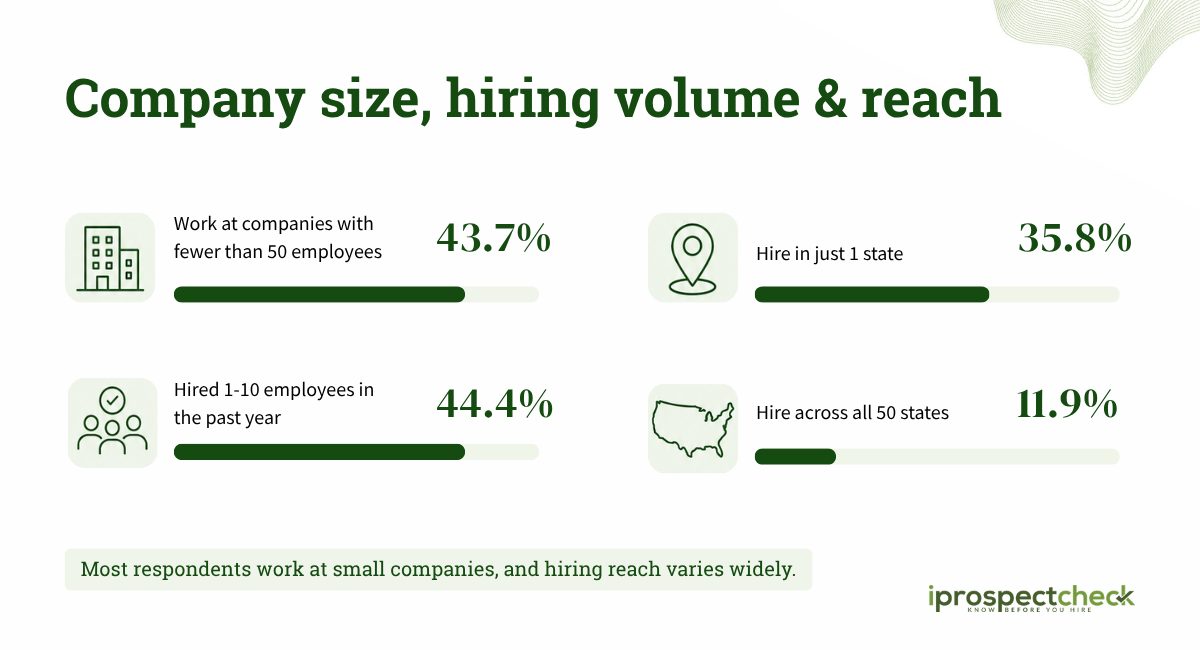
Most of the respondents we surveyed work in small companies. 43.7% employ fewer than 50 people, and 44.4% hired somewhere between 1 and 10 employees in the past year. Despite this, and probably due to the surge in work-from-home employees, recruitment reach varies considerably: 11.9% of employers now hire across all 50 states, while 35.8% still hire in just one.
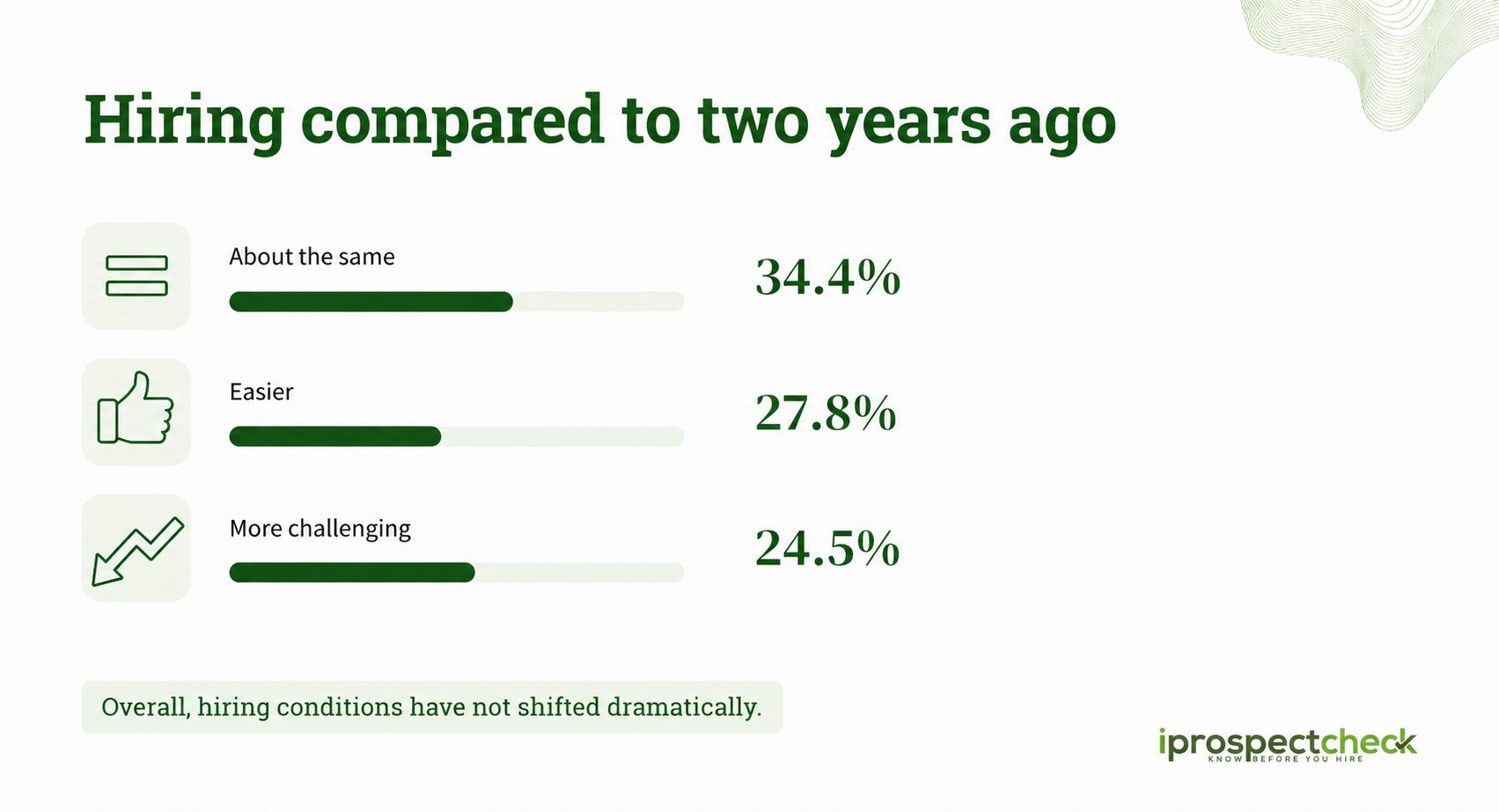
We found that recruitment conditions have not moved significantly in either direction. Over one in three (34.4%) respondents say the process remains roughly the same as two years ago, whereas 24.5% say it’s become more challenging. A further 27.8% say it’s actually easier.
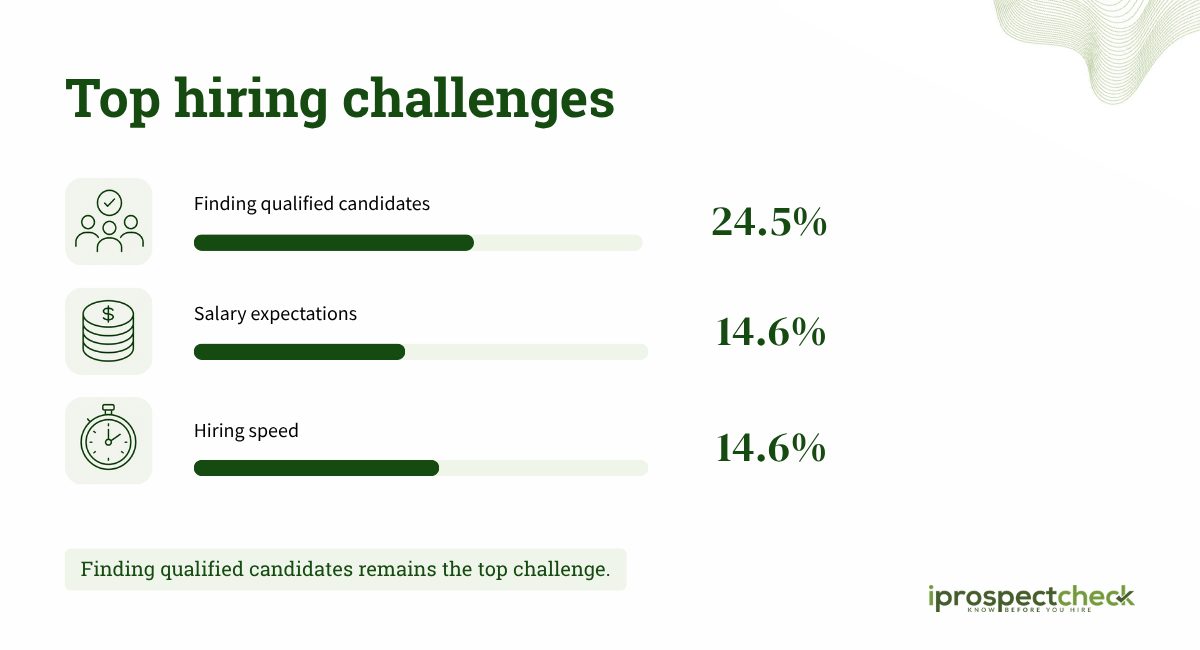
They say that the single biggest challenge is still finding qualified candidates (24.5%), with salary expectations and hiring speed tied close behind at 14.6% each.
What this means for the hiring process: It appears the hiring market isn’t in crisis, but neither is it stable. Screening and verification need to work whether you’re making five hires in one state or scaling a national rollout, without slowing anything down at either end.
How Employers Are Adapting to AI in Hiring
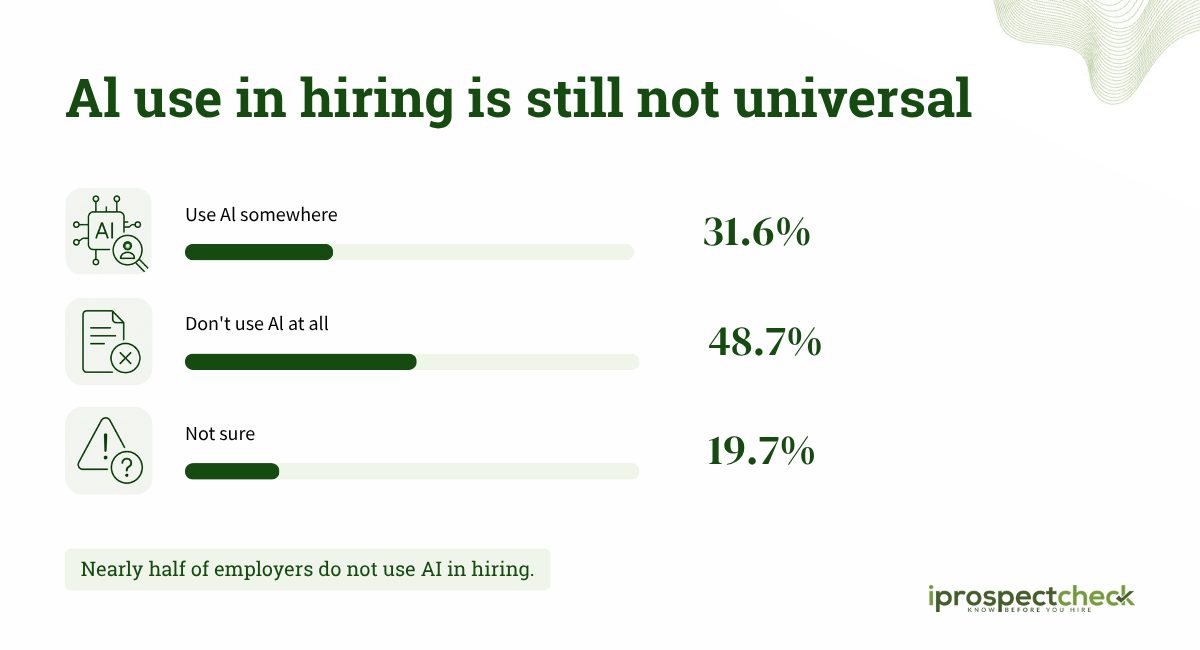
AI adoption in hiring is real, but it’s nowhere near universal. 31.6% of companies use it somewhere in the process, 48.7% don’t use it at all, and 19.7% aren’t sure.
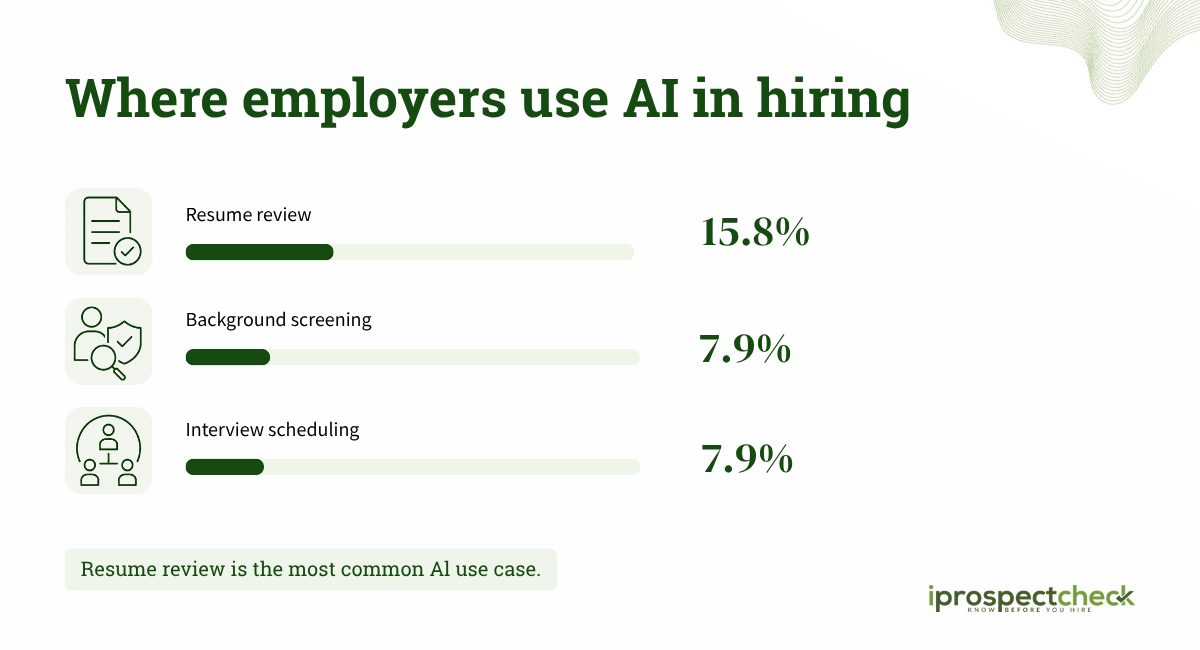
Where it is used, resume review leads the way (15.8%), with background screening and interview scheduling tied for second (7.9% each).
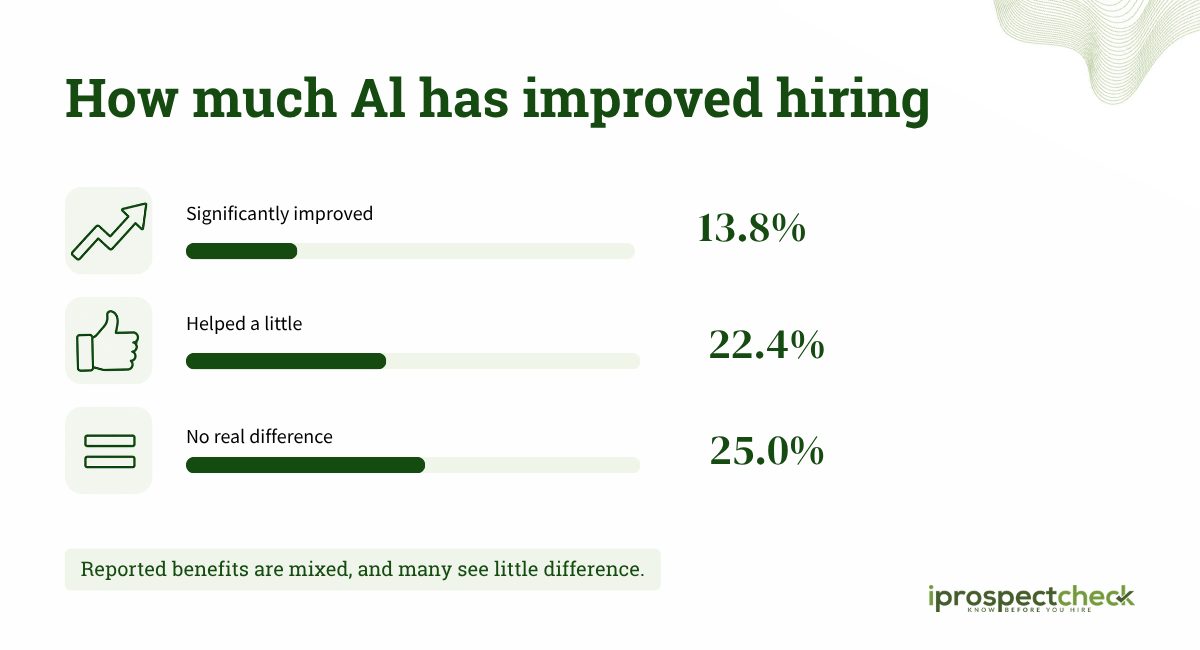
Results are genuinely mixed. Only 13.8% say AI has significantly improved their hiring process, 22.4% say it’s helped a little, and a full quarter (25.0%) report no real difference at all.
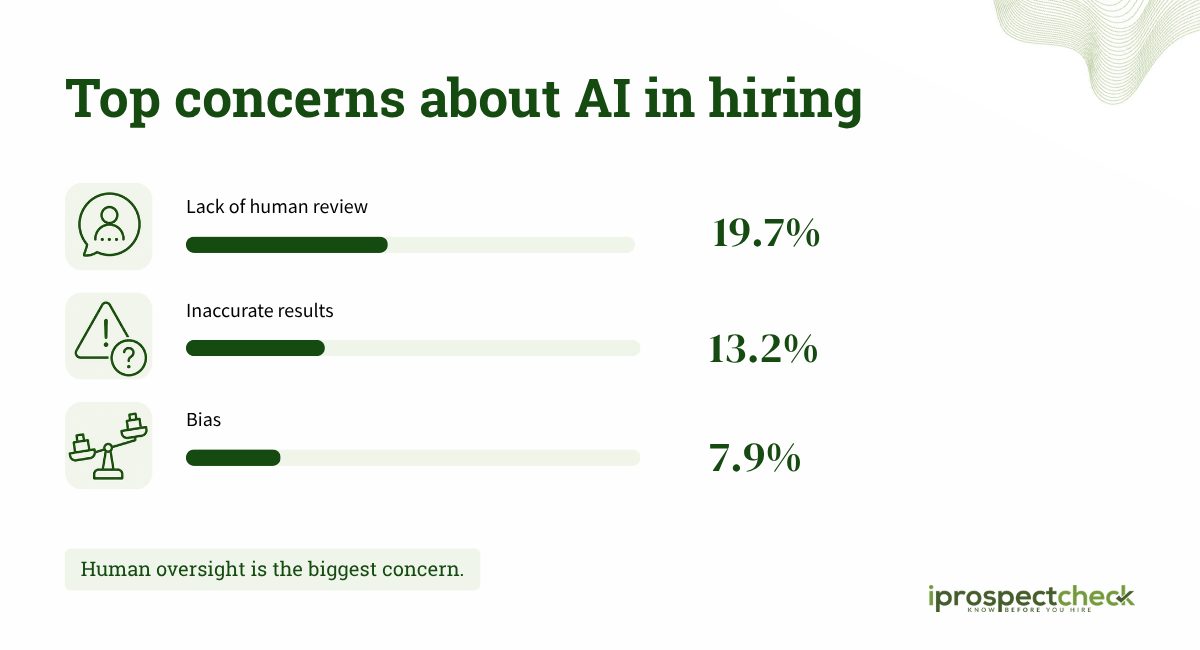
The concern isn’t really about the technology itself so much as what happens when no one’s double-checking it: 19.7% named lack of human review as their top worry, ahead of inaccurate results (13.2%) and bias (7.9%).
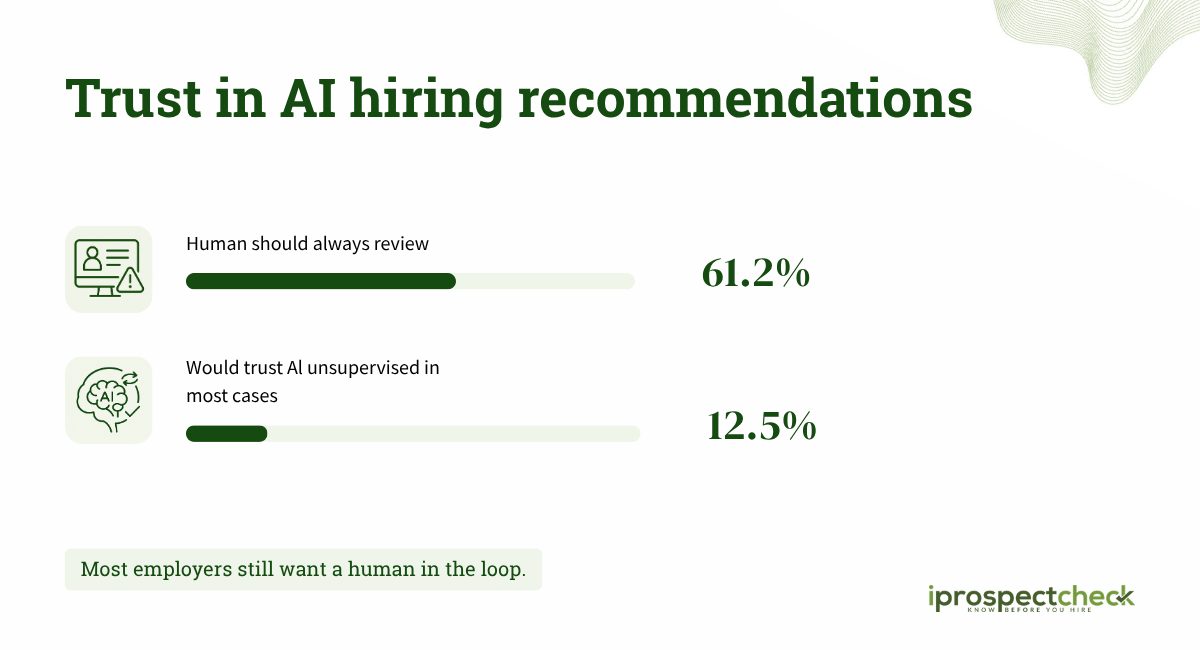
That instinct comes through clearly elsewhere too – 61.2% think a human should always review AI hiring recommendations, and only 12.5% would trust AI to make those recommendations unsupervised in most cases.
What it means for employers: Use AI where it saves time – sorting resumes, scheduling – but keep a mandatory human checkpoint before any hiring decision gets finalized. That’s not being overly cautious. It’s what most employers are already doing.
“AI can sort through a stack of resumes faster than any person ever could. What it can’t do is take responsibility when something goes wrong. And if AI can breach a secured sandbox to breach another company’s data, how safe is it really? The moment you let an algorithm make the call on who gets hired, you’ve given up something no employer should ever relinquish: human judgement and accountability. Human beings may not be perfect, but we have a long history of getting it right over time.” says Matthew J. Rodgers, Founder and President, iprospectcheck.
Identity Fraud and the Verification Gap
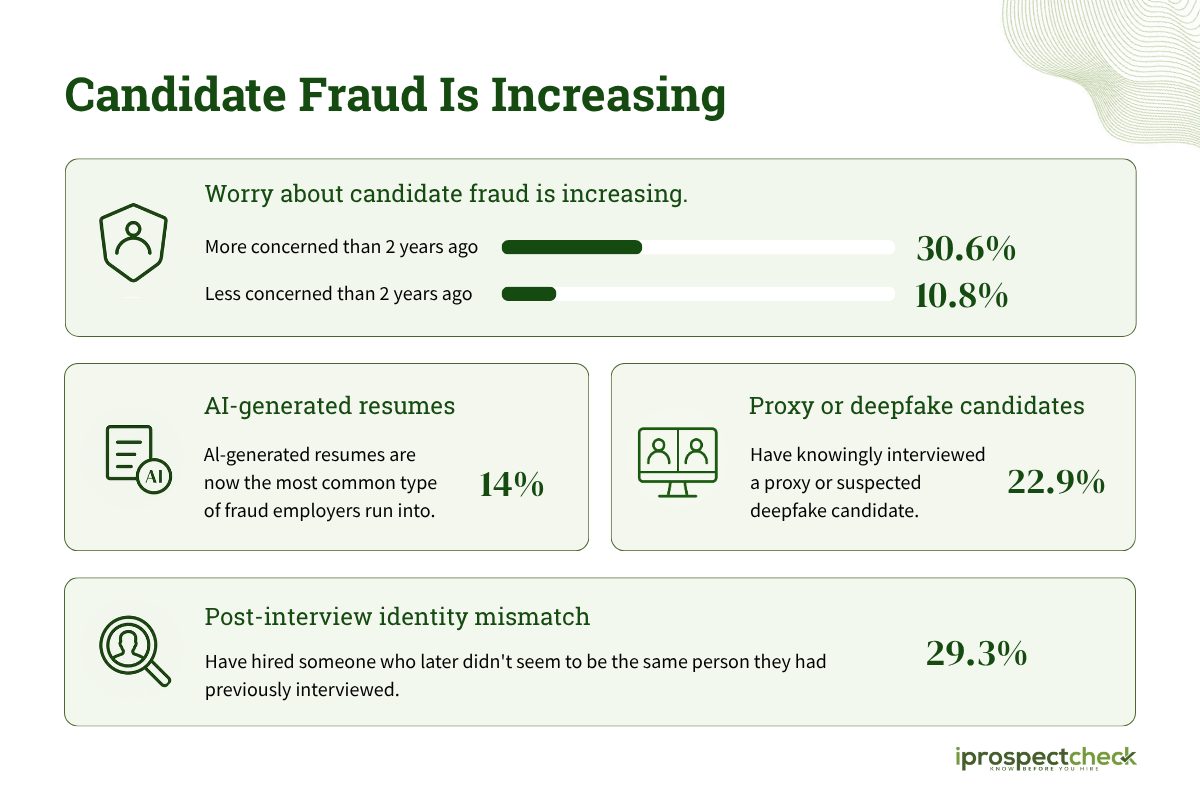
Worry about candidate fraud is increasing. 30.6% of employers say they are more concerned than they were two years ago, versus just 10.8% who feel less concerned.
AI-generated resumes are now the most common type of fraud employers run into (14.0%), and 22.9% say they have knowingly interviewed a proxy or suspected deepfake candidate. Close to 3 in 10 (29.3%) say they have hired someone who later didn’t seem to be the same person they had previously interviewed.
Identity verification itself is still inconsistent. Government-issued ID is the most common check (31.8%), but 5.1% of companies admit they don’t formally verify identity at all before hiring, and 22.3% aren’t even sure what their own process covers. Given all that, it’s not surprising that 80.9% of employers now think identity verification should be standard, and 67.5% say it should apply to every role, not just sensitive ones.
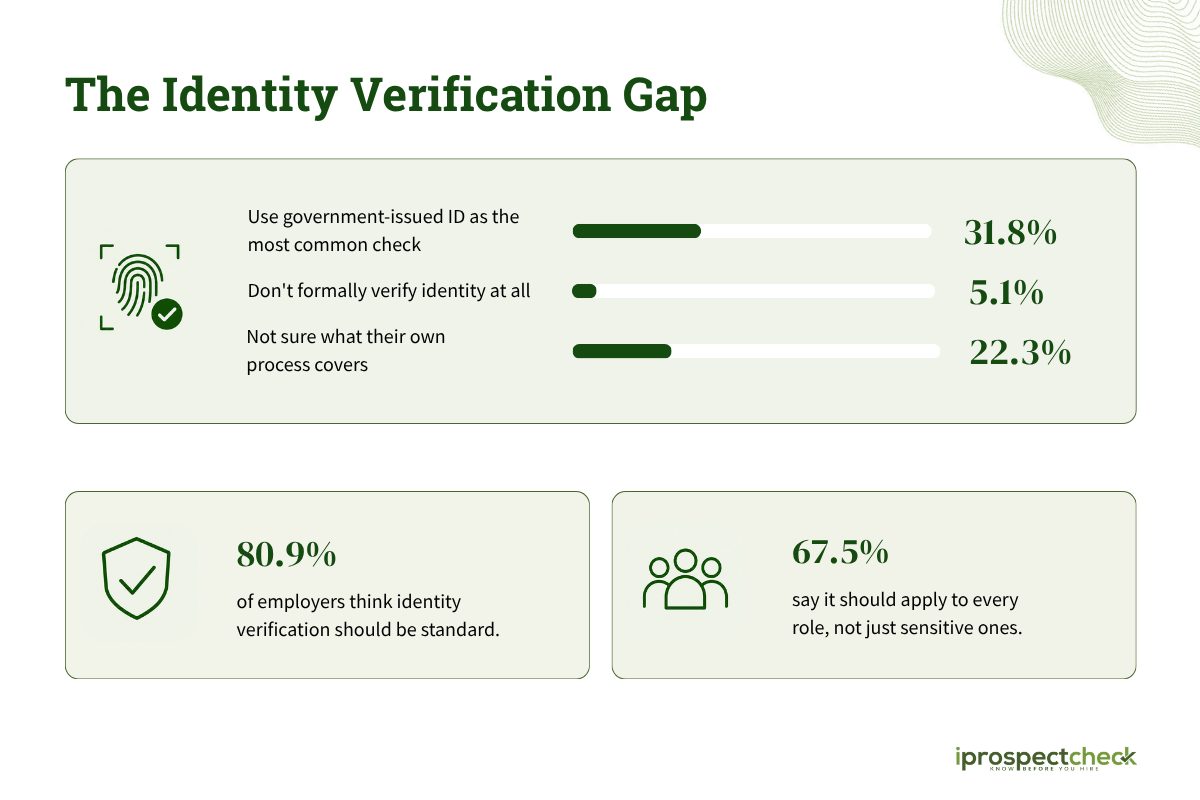
What it means for employers: Identity verification is quickly moving from “nice to have” to baseline expectation. If it’s not already built into your screening process, you’re behind where most of your industry says it should be.
“We’re seeing employers who never used to think twice about whether someone actually is who they say they are now asking that question every week. Deepfake interviews and proxy candidates used to sound like science fiction. Now it is the norm.” says Matthew J. Rodgers.
Resume Red Flags: Employment and Education Verification
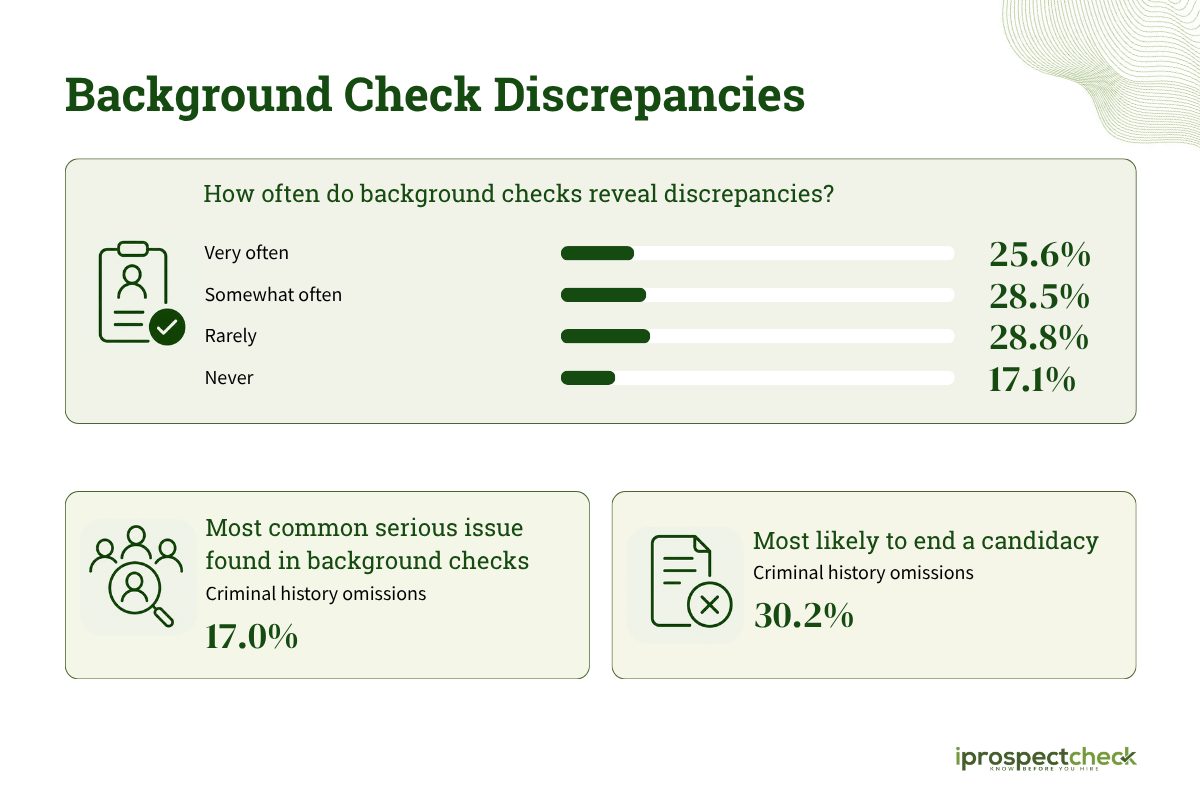
Background checks are turning up real discrepancies, not just paperwork mismatches. Over half of employers (54.1%) say checks reveal discrepancies “very often” or “somewhat often,” and criminal history omissions are both the most common serious issue (17.0%) and the one most likely to end a candidacy (30.2%).
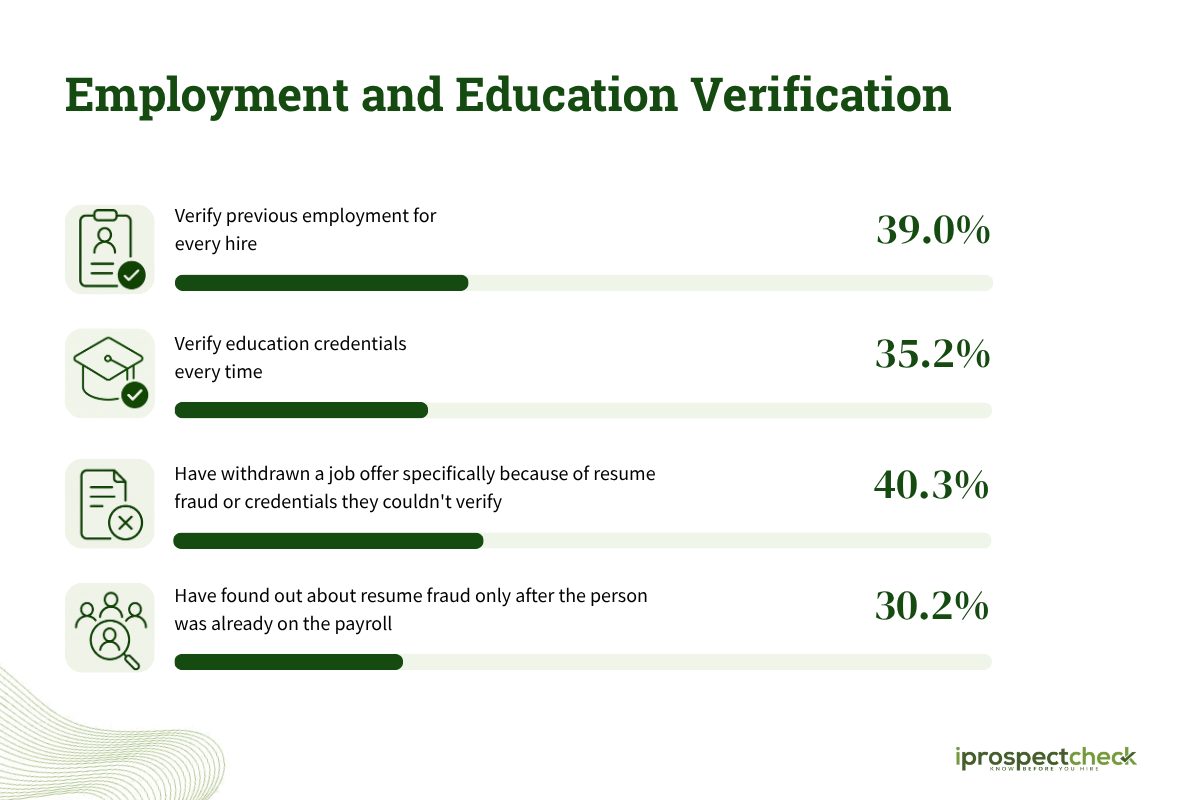
Verification itself is uneven, though. Only 39.0% of companies verify previous employment for every hire, and 35.2% verify education credentials every time – which means most employers are taking at least part of a candidate’s resume on faith. That catches up with them later: 40.3% have withdrawn a job offer specifically because of resume fraud or credentials they couldn’t verify, and 30.2% have found out about resume fraud only after the person was already on payroll.
What it means for employees: Padding a resume carries more risk than it used to. Employers are verifying more, not less, and the consequences of getting caught – a rescinded offer, or a termination after the fact – are common enough now that they should factor into how candidates present their history.
Background Screening in Practice: Speed, Accuracy, and Candidate Experience
Close to 6 in 10 employers (59.5%) run a background check on every candidate before hiring, most often a criminal background check (29.7%). Timing varies quite a bit: 34.8% screen after the interview but before making an offer, while 16.5% wait until after a conditional offer – the sequencing that lines up best with Fair Chance Hiring practices.
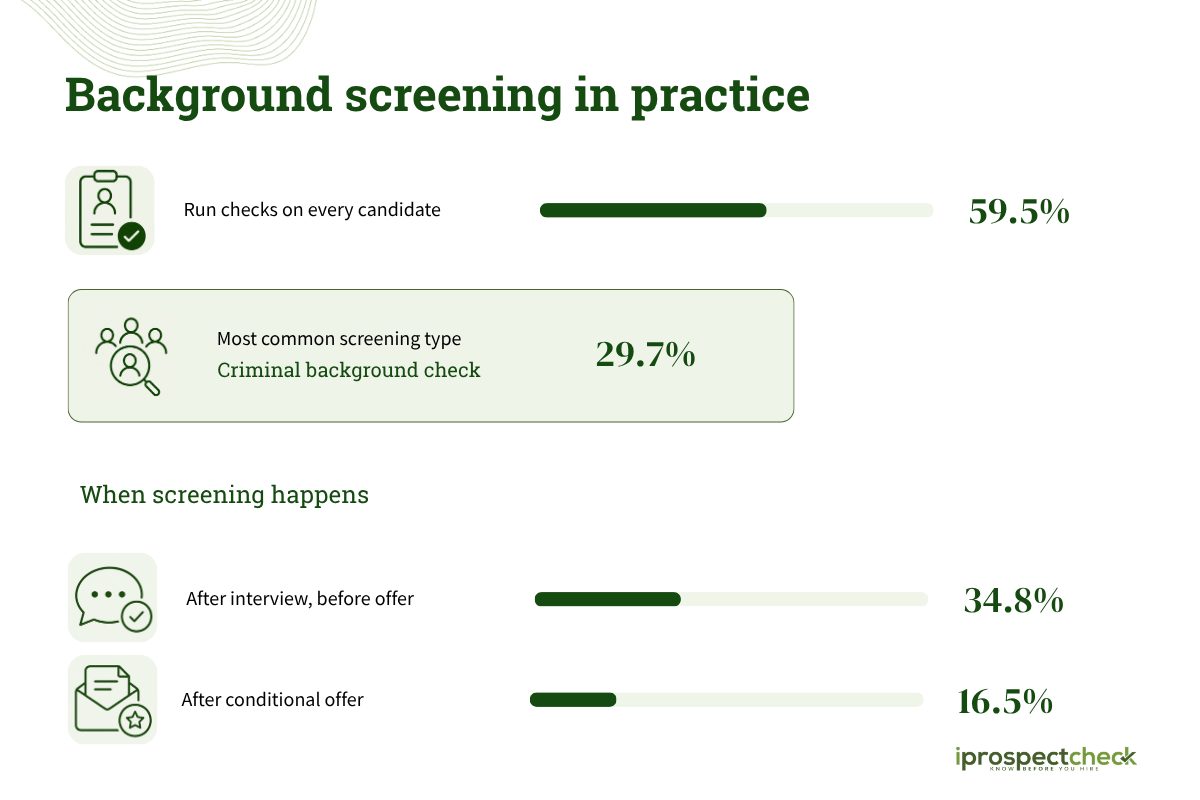
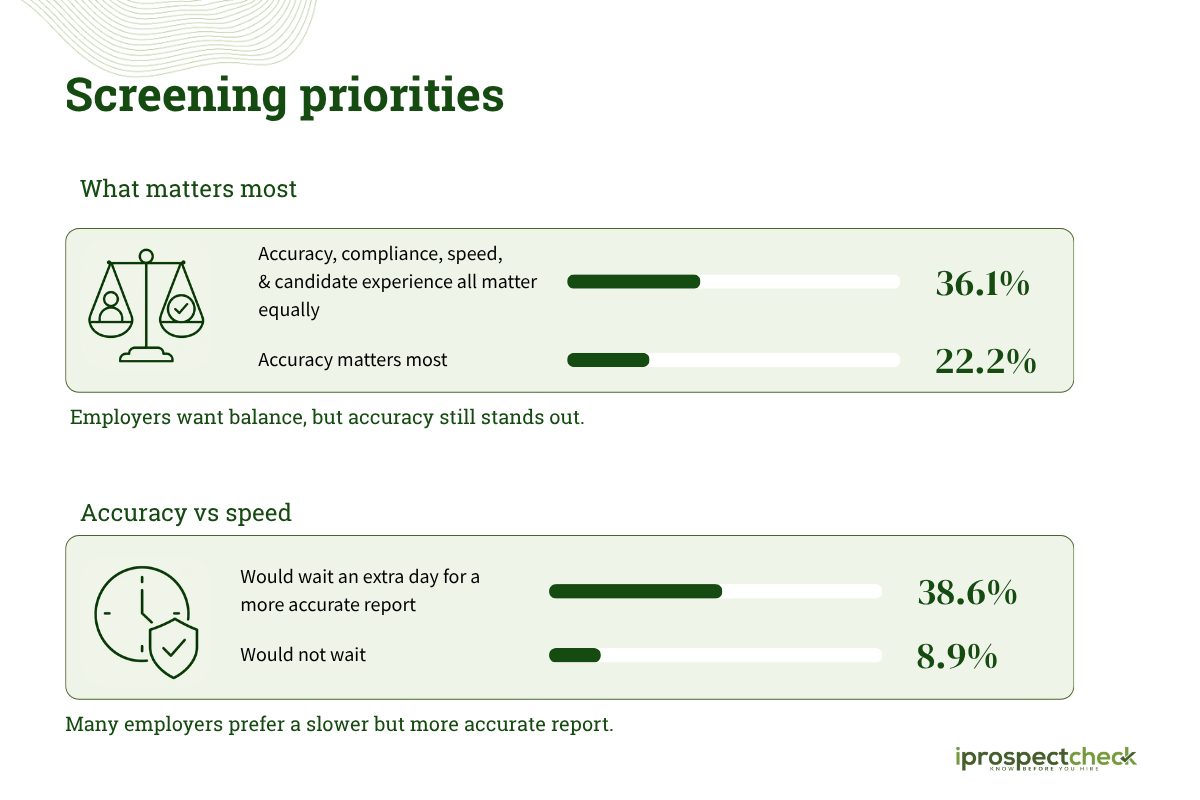
Speed matters, but not more than getting it right. When asked what matters most in screening, 36.1% said accuracy, compliance, speed, and candidate experience all matter equally, while accuracy alone was still the top single answer (22.2%). A further 38.6% of respondents said they would prefer to wait an extra day for a more accurate report than get a quicker one – this compares to just 8.9% who say they wouldn’t.
On the candidate side, 29.8% of employers say candidates have complained about the screening process – their top complaints were about delays in the process (16.9%), followed by poor communication (13.6%). When they were asked specifically about what would improve the experience most, better communication (24.7%) emerged as the top response, followed by a faster turnaround (22.7%).
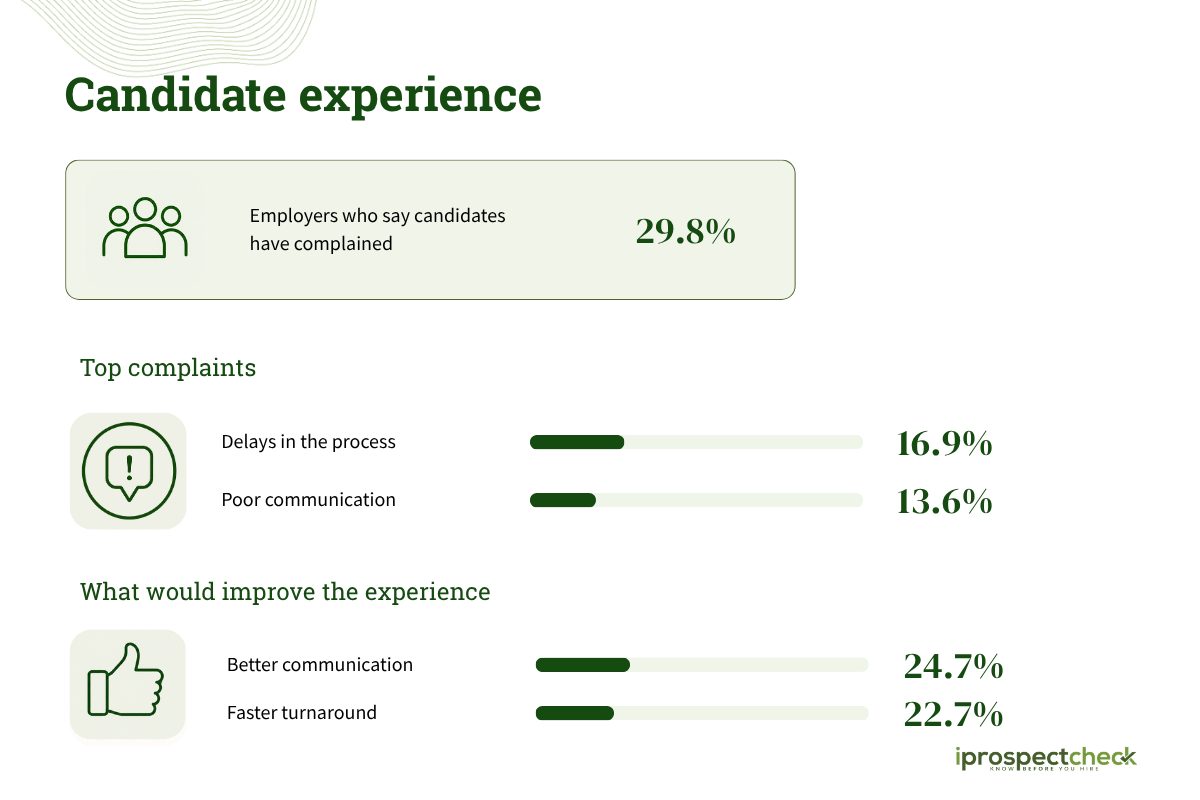
What it means for employers: Job candidates do not expect instant results. Instead, what they prioritize is to know how the process works. In other words – a short delay combined with clear communication supersedes a fast process that leaves candidates guessing.
Compliance Challenges: Confidence vs. Readiness
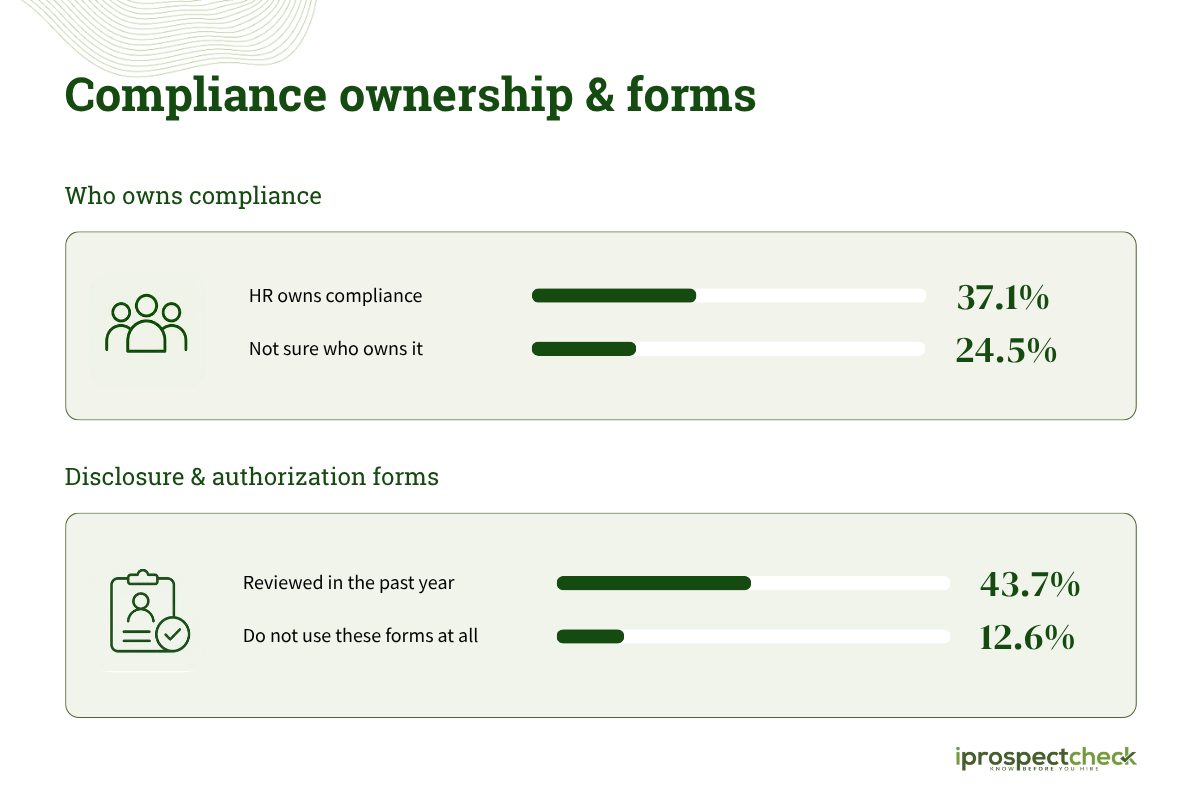
This is where the biggest disconnect shows up in our research. Nearly three-quarters of employers (72.9%) say they are confident their hiring process complies with applicable screening laws. But confidence isn’t the same as documentation – only 40.4% actually have a written adverse action process, and 43.7% aren’t sure one even exists at their company.
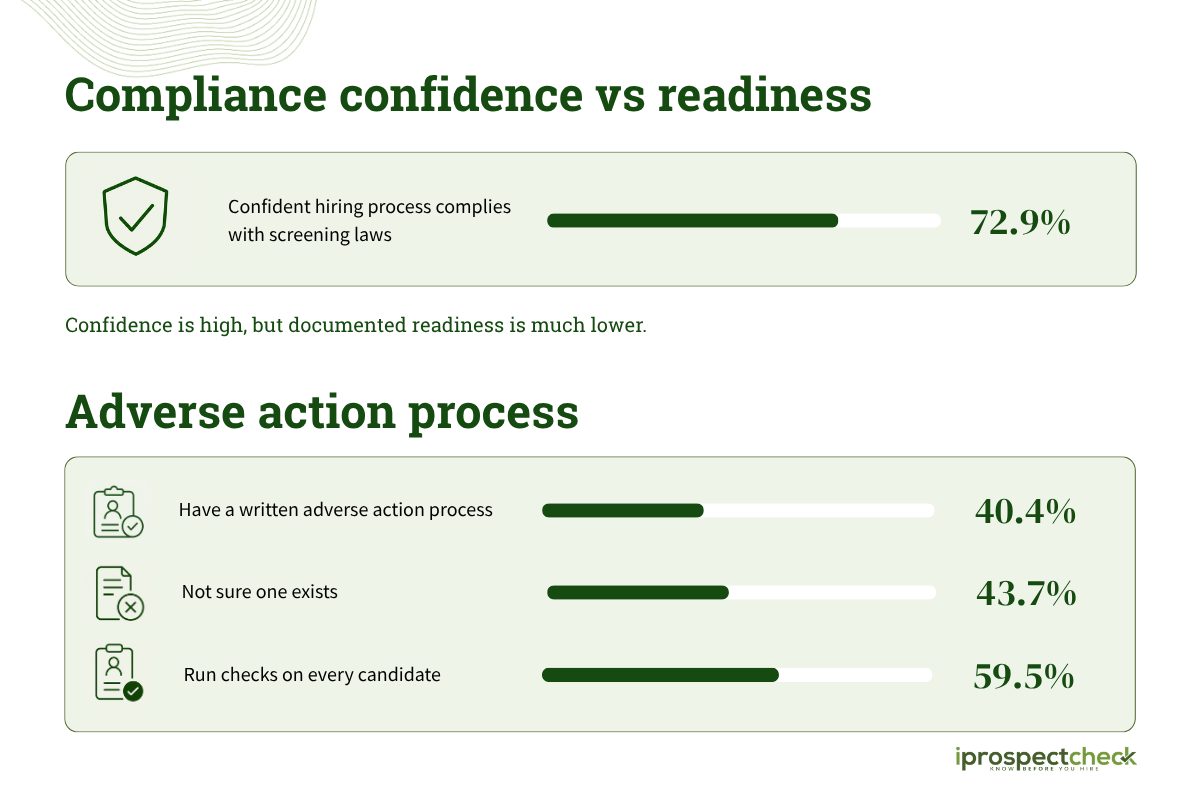
HR carries most of that weight: 37.1% of companies place compliance ownership with HR, and 24.5% aren’t sure who owns it at all. Disclosure and authorization forms, a routine FCRA requirement, had been reviewed in the past year at only 43.7% of companies, and 12.6% don’t use these forms at all.
As for what worries employers looking ahead, no single issue dominates – state and local law differences (14.6%) and AI-related compliance (10.6%) top the list, but 37.1% weren’t sure which risk concerned them most.
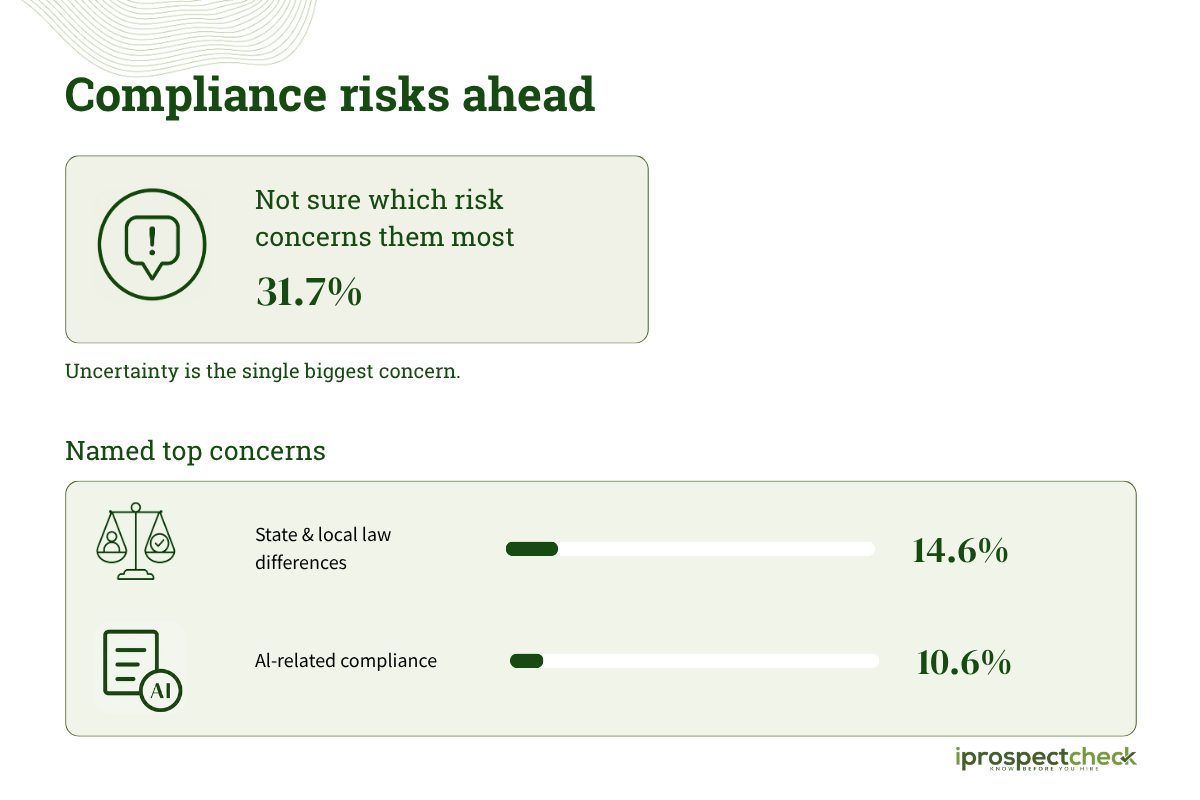
What it means for employers: Confidence without documentation isn’t an asset; it’s a liability. An adverse action process that only exists informally doesn’t really exist, not in the eyes of a regulator or a plaintiff’s attorney.
Matthew J. Rodgers continues: “Confidence and readiness are two different things. Plenty of companies feel good about their compliance right up until an actual adverse action letter has to go out, and that’s exactly when the gaps in the process show up.”
Human Review vs. Automation: Where Employers Draw the Line
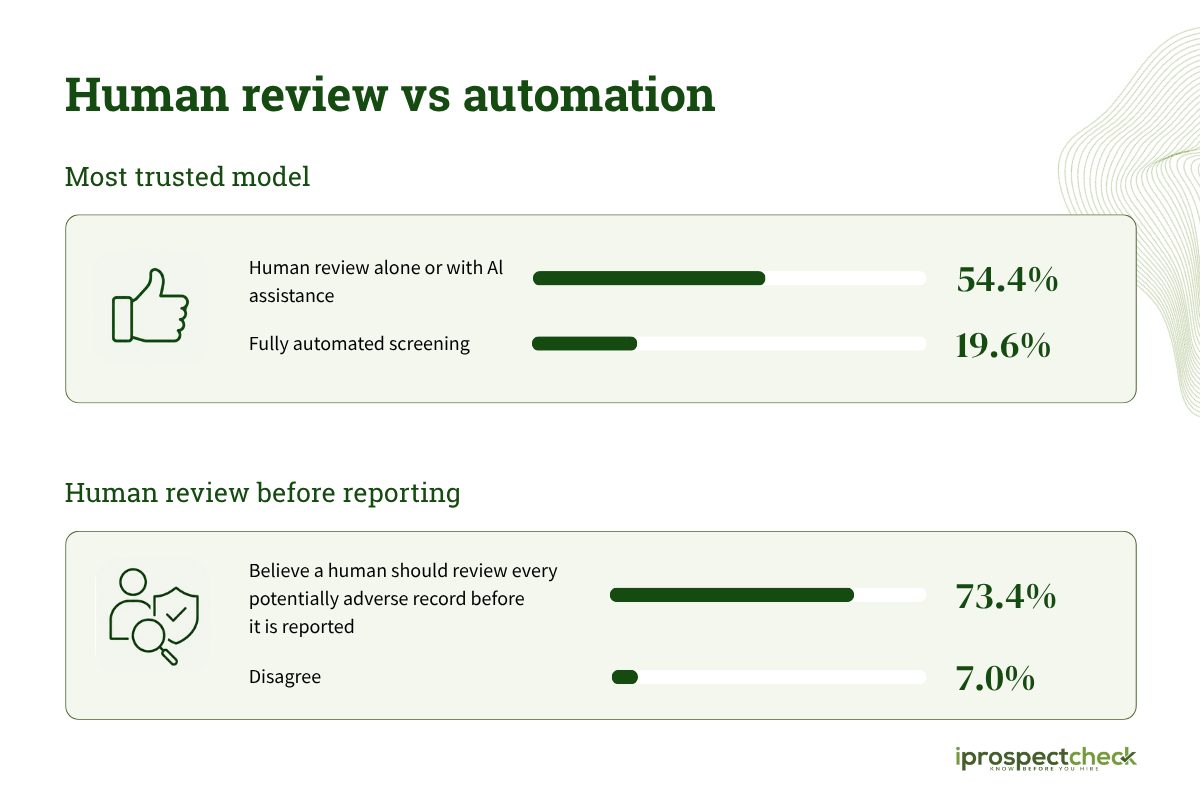
Employers want people making the final call, not just algorithms. Human review alone, or human review with AI assistance, was the most trusted model for 54.4% of respondents, compared to just 19.6% who trust fully automated screening. Asked directly, 73.4% believe a human should review every potentially adverse background check record before it gets reported, and only 7.0% disagreed.
There’s a clear line in how far employers will let AI go. 51.9% are comfortable with AI flagging records for a human to look at, but only 32.3% would let it decide on its own whether something is reportable – 53.2% say no to that. A further 46.8% say they would be willing to pay more for human quality assurance built into their screening process, while another 24.1% said it depends on price. This suggests the appetite for oversight is present, so long as the cost makes sense.
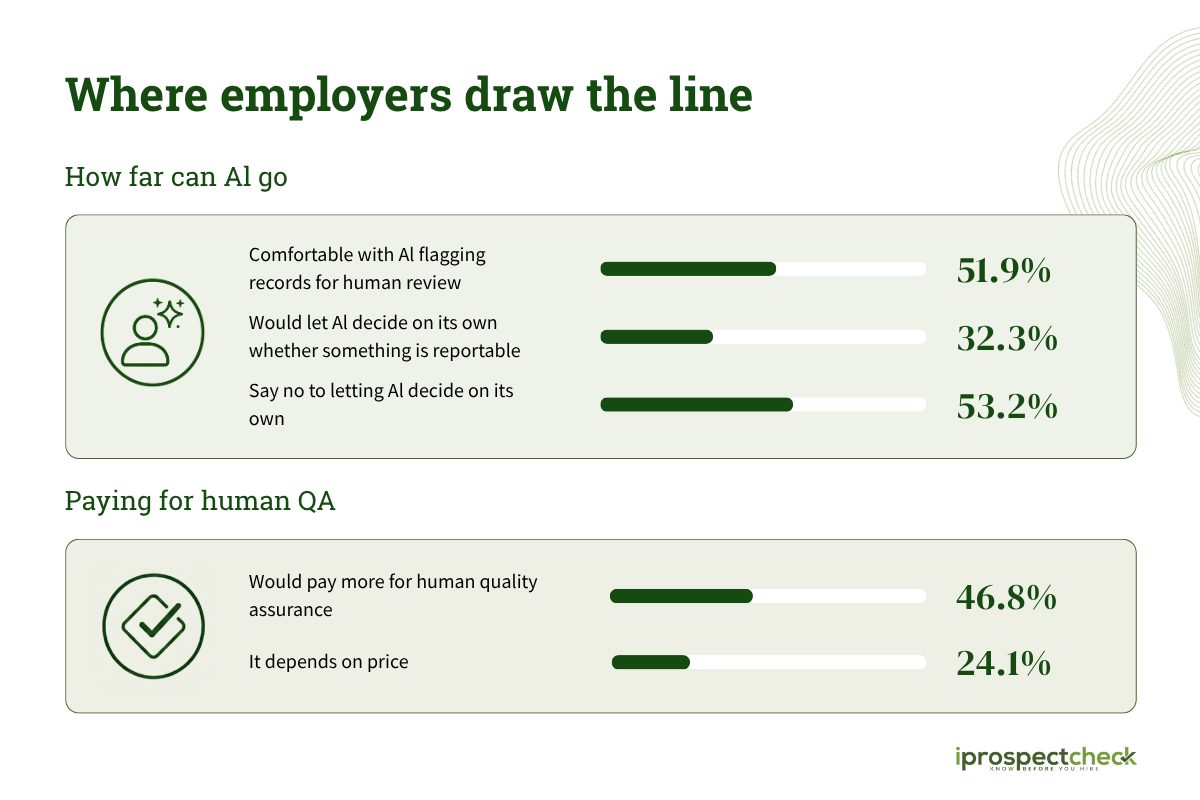
What it means for employers: Most employers clearly agree that AI belongs in an assistive role in background screening, but not a decision-making one, at least for now.
Social Media Screening: Opportunity Meets Caution
Social media screening is still a minority practice. 22.3% of companies use a formal provider, 12.1% screen informally through HR, and 37.6% don’t screen social media at all. Among those who don’t, privacy concerns are cited as the main reason (22.9%), clearly ahead of compliance concerns (7.6%) or simply not having a clear policy (5.7%).
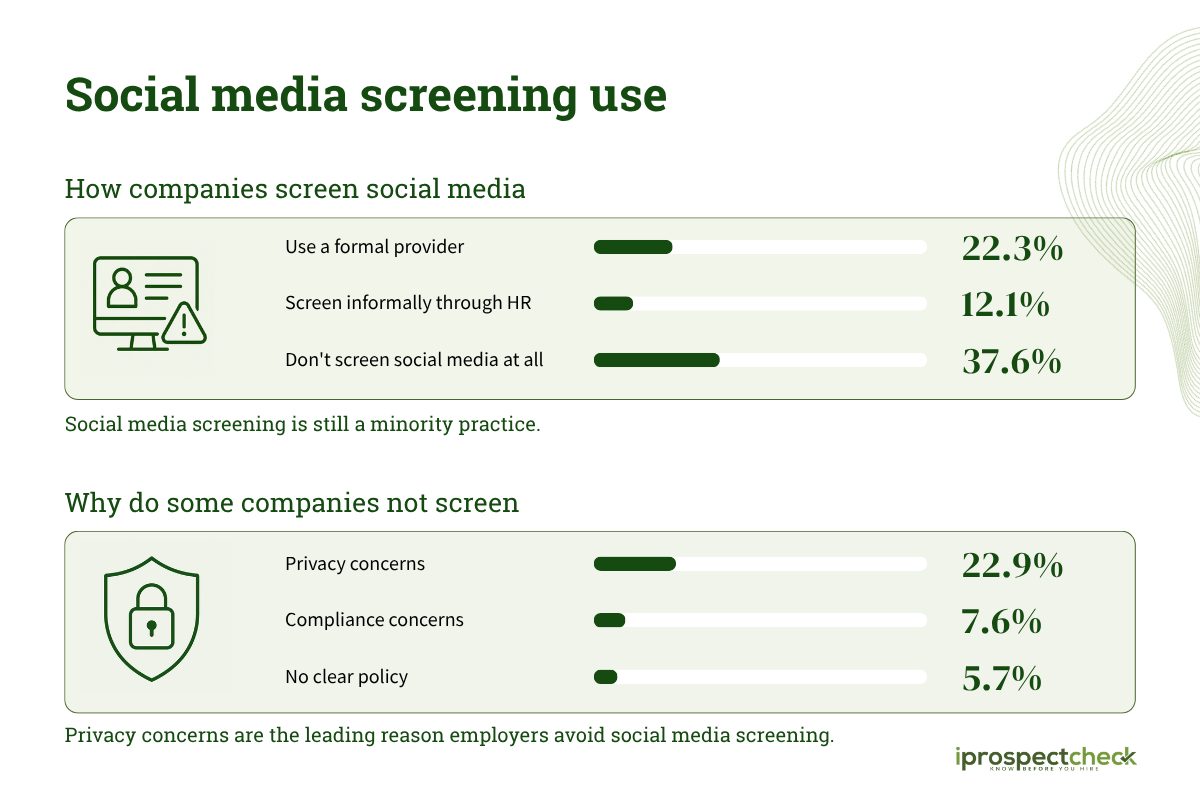
When employers do check candidates’ social media, they are usually focused on specific red flags rather than broad checks: these red flags include threats or violent content (17.8%) and hate speech (14.6%), while political views barely register (1.9%). Social media findings have actually changed a hiring decision at 24.2% of companies. And there’s a clear preference forming for how this should be handled – 29.3% of employers would rather use a compliant third-party provider than have HR search manually, and another 26.8% said it depends on cost, meaning a combined majority is open to outsourcing this if it’s done right.
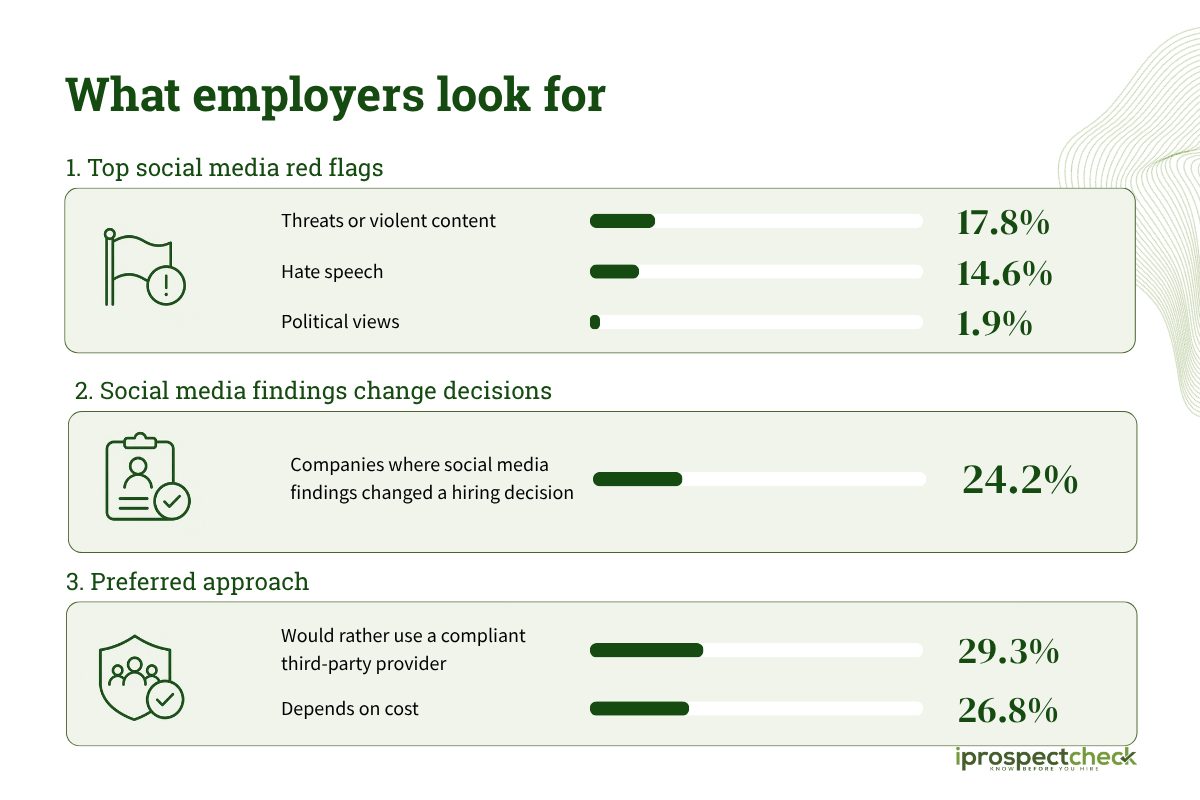
What it means for employers: Ad hoc social media searches by hiring managers create more legal risks than a structured, compliant screening process does.
Choosing a Screening Provider: What Employers Value Most
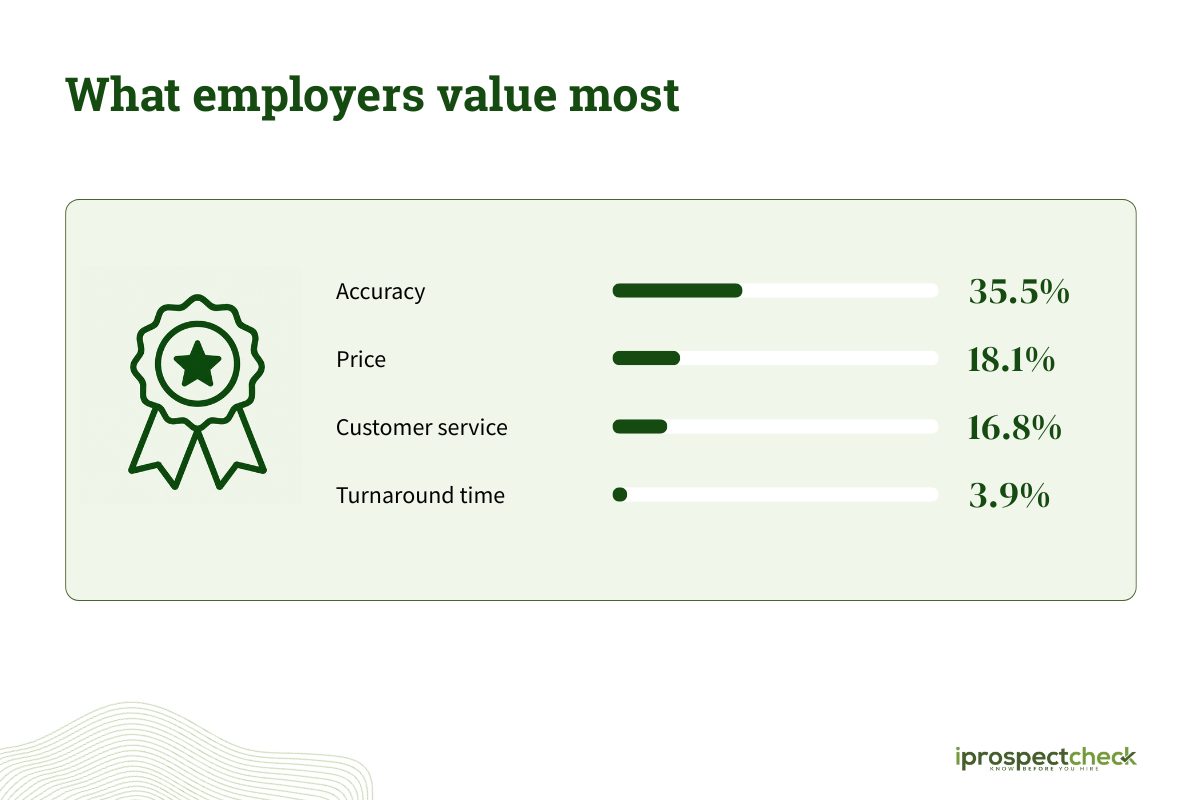
Accuracy wins by a wide margin when employers choose a background screening provider. It was cited as the most important factor by 35.5% of respondents – this was followed by price, at 18.1%. Customer service (16.8%) ranked well ahead of turnaround time (3.9%).
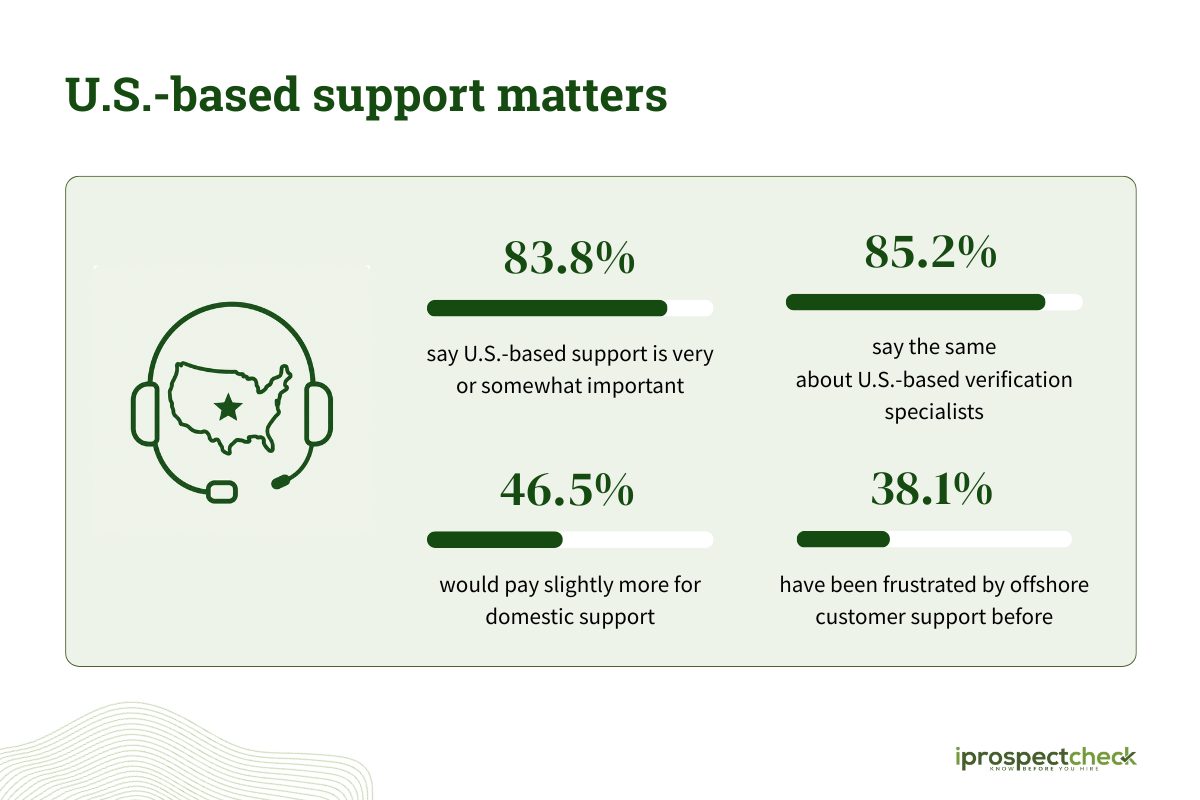
U.S.-based support turned out to matter more than a lot of providers probably expect. 83.8% of employers said it’s very or somewhat important, and 85.2% said the same specifically about having U.S.-based verification specialists. 46.5% said they would be willing to pay slightly more for domestic support, and 38.1% admitted to having been previously frustrated by offshore customer support from a screening or HR tech vendor before.
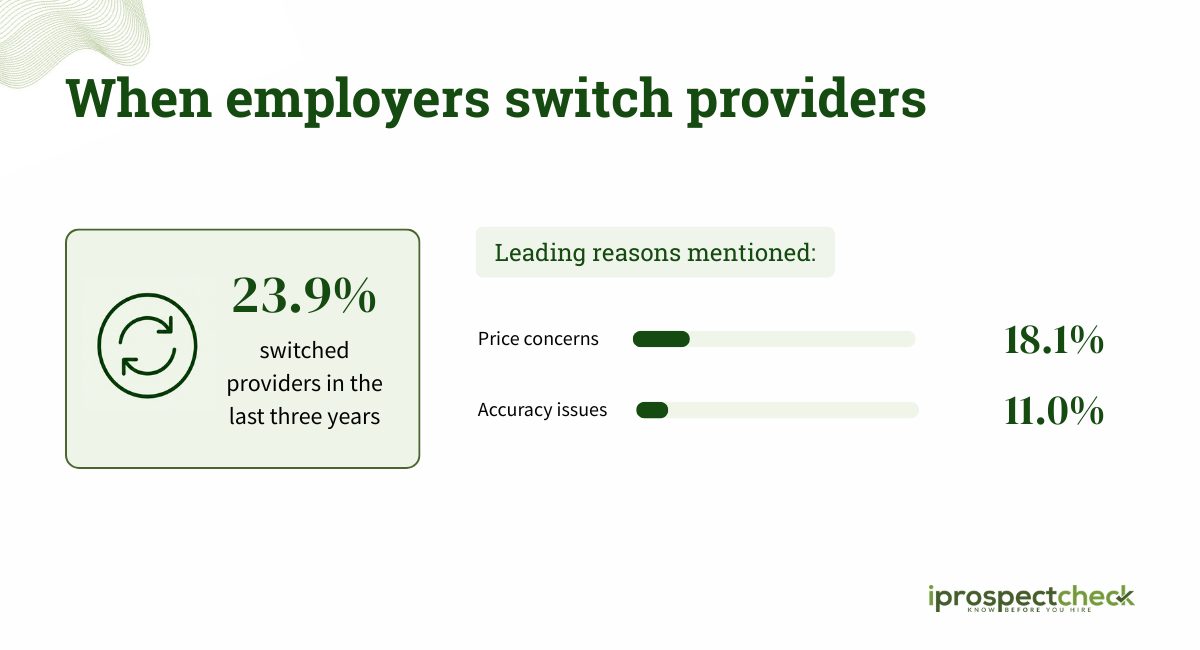
Among the 23.9% of companies that said that they had switched providers in the last three years, concerns about price (18.1%) and accuracy issues (11.0%) were the leading reasons mentioned.
What it means for employers: When considering a provider and then asking them about pricing, two things should be front of mind: ask where their support and verification teams are actually based, and what their accuracy track record looks like on disputed reports.
“Price gets attention, but service and accuracy keep clients”, says Mr Rodgers. “Almost every company that’s ever switched providers tells us some version of the same story.”
Looking Ahead: Investment Priorities and Emerging Risk
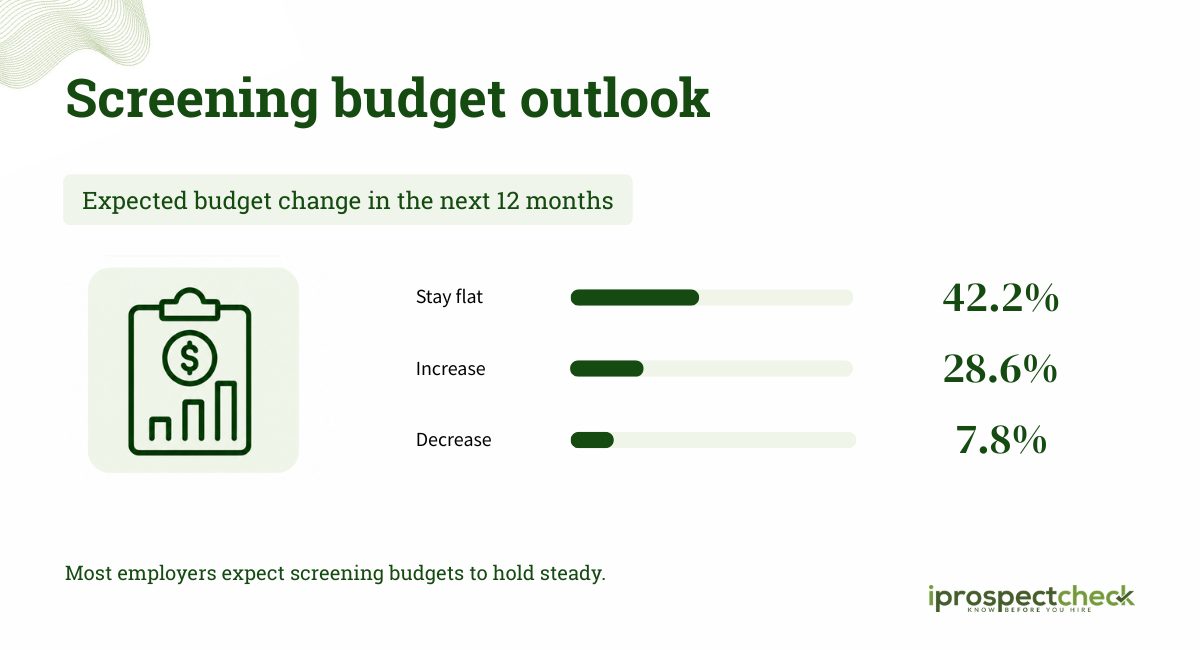
The data shows that screening budgets are holding steady rather than growing. 42.2% of employers expect their budget to stay flat over the next 12 months, while 28.6% expect an increase. Only 7.8% expect a decrease.
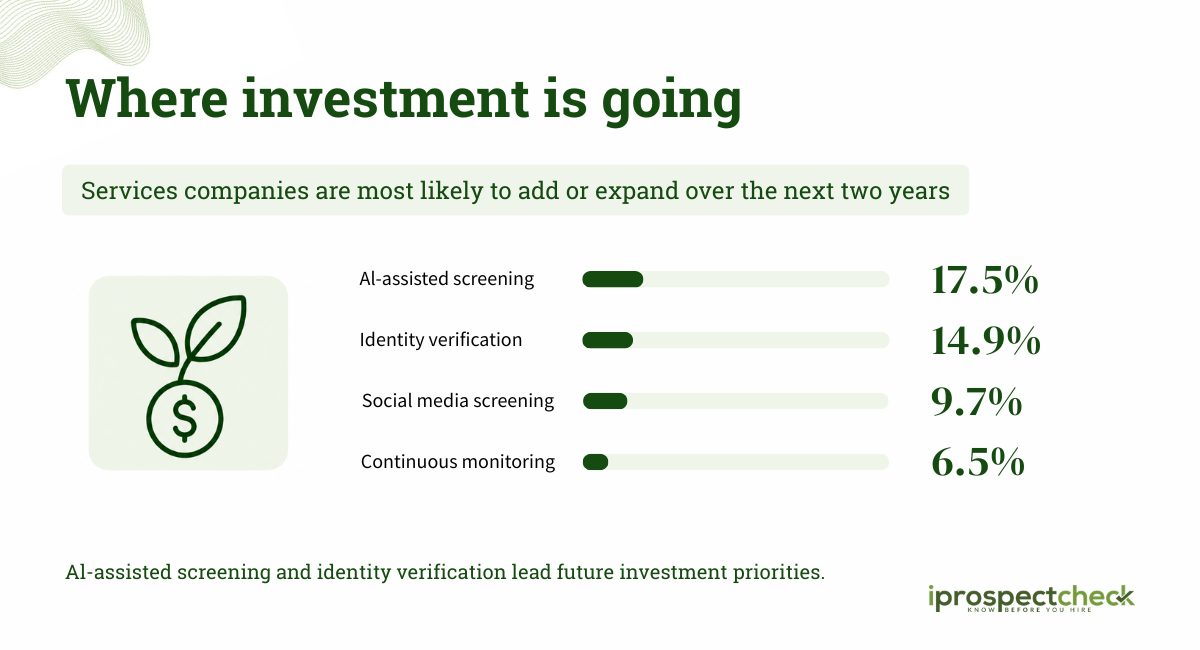
Where new budgets are being poured into lines up with the risks this survey uncovered: AI-assisted screening (17.5%) and identity verification (14.9%) are the two services companies are most likely to add or expand over the next two years. These were comfortably ahead of continuous monitoring (6.5%) and social media screening (9.7%).
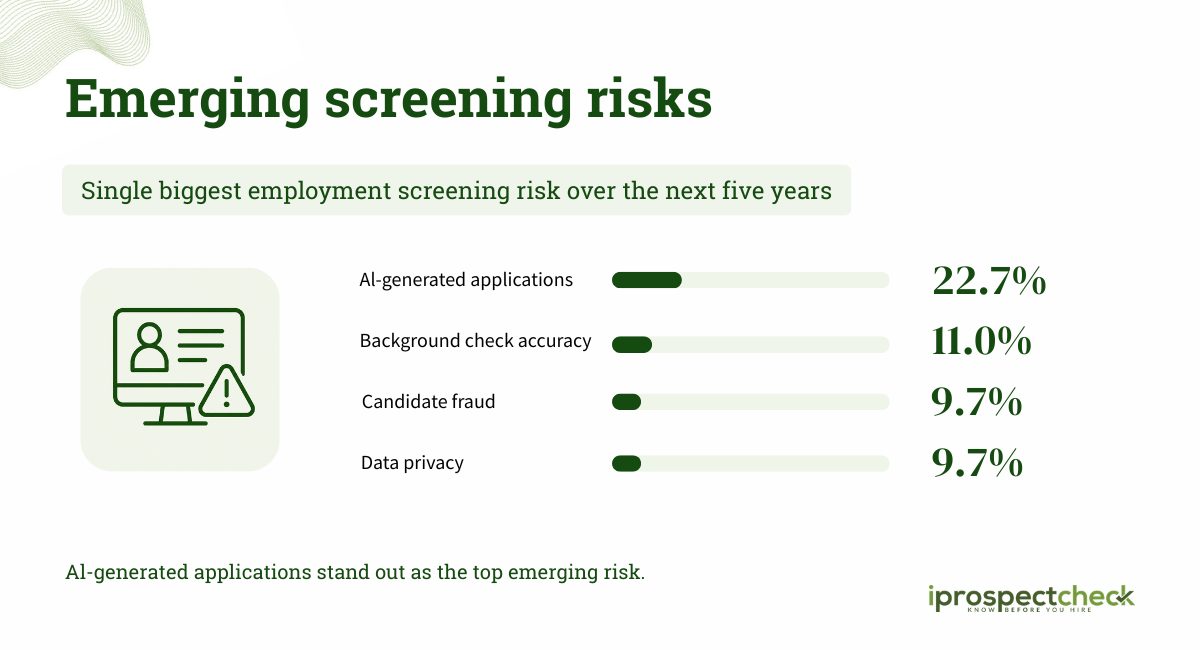
Asked to name the single biggest employment screening risk over the next five years, AI-generated applications topped the list at 22.7%, more than double any other single answer, ahead of background check accuracy (11.0%), candidate fraud (9.7%), and data privacy (9.7%).
What it means for employers: The very same employers who are most worried about AI-generated applications are, broadly speaking, the same ones already planning to invest in AI-assisted screening and identity verification.
“Employers aren’t waiting around for regulation to catch up with AI. Many are already building their own guardrails, because the cost of getting a hiring decision wrong is a lot higher than the cost of a better screening process,” – continues Matthew J. Rodgers.
Action Checklist for Employers
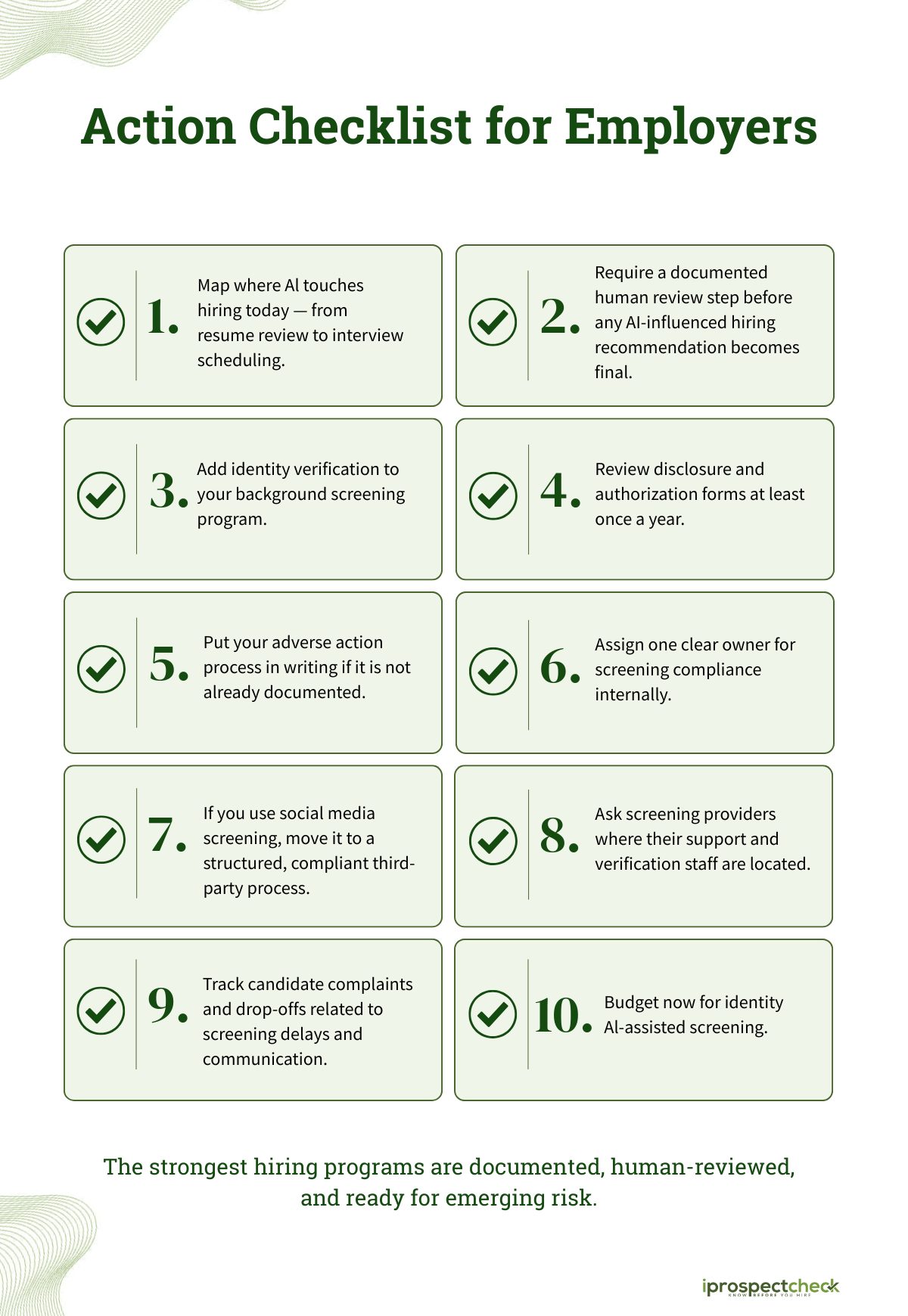
- Plan exactly where AI touches your hiring process today, from resume review to interview scheduling. Most HR teams underestimate how much ground they’re already covering.
- Insist on having a documented human review step before any AI-influenced hiring recommendation becomes final.
- Try to include identity verification in your background screening program.
- Review your disclosure and authorization forms at least once a year. “We’ve always used this form” is a compliance risk, not a defense.
- Put your adverse action process in writing if it isn’t already. A regulator will treat an informal process as the same as not having one at all.
- Assign clear, single ownership of screening compliance internally, rather than leaving it split across HR, legal, and hiring managers.
- If you use social media screening, move it to a structured, compliant third-party process instead of ad hoc manager searches.
- Ask prospective screening providers directly where their support and verification staff are located.
- Track candidate complaints and drop-offs related to screening delays. Better communication often matters more than raw speed.
- Budget for identity verification and AI-assisted screening now. These are the two services your peers are adopting fastest.
Conclusion
Three findings stand out across this research. First, employers want AI involved in hiring, but only as an assistant. The demand for human review, from resume screening to adverse action, is close to universal. Second, an applicant’s identity has become a real business risk rather than a compliance footnote. Four in five employers now think it deserves standard verification. Finally, believing you are compliant and proving it are entirely different – that gap is precisely where the next wave of hiring risk is likely to show up.
None of this means that employers should now dismantle their hiring process and start from scratch. Instead, it calls for treating background screening as an integrated infrastructure rather than an afterthought: it should be reviewed regularly, documented properly, and built for a workforce and a candidate pool that already looks meaningfully different than it did two years ago.
Methodology
Respondents came from a geographically representative, double opt-in online panel, screened specifically for business managers and company owners with direct visibility into their organization’s hiring decisions.
Every question was built to authenticate respondents and keep the sample aligned with that target group. We ran the data through several quality checks – digital fingerprinting, bot detection, geo-verification, speeding checks – and then had a team member manually review every response for quality and context. Open-ended answers were also checked for gibberish and plagiarism.
A total of 1,500 business managers and company owners completed the survey in full. All figures are rounded to one decimal place; totals on multi-select questions can add up to more than 100%.
FAQs
How are employers adapting to AI in hiring?
Only one in three companies currently uses AI anywhere in hiring, most often for resume review. Most of these companies still integrate human review into the process before a final decision. Moreover, 61.2% believe a human should always review AI-generated hiring recommendations.
What is AI identity fraud in hiring, and how common is it?
AI identity fraud ranges from AI-generated resumes to deepfake video interviews and proxy candidates who interview on someone else’s behalf. Our survey found that 14% of employers had encountered AI-generated resumes at some point, while 22.9% had knowingly interviewed a suspected proxy or deepfake candidate.
Do most companies verify a candidate's identity before hiring?
Not always – our survey found that Government-issued ID is the most common method (31.8%), yet 5.1% of companies don’t formally verify identity at all. However, 80.9% of employers we surveyed think identity verification should become a standard part of background screening.
What are the biggest compliance challenges in employment screening?
Mainly the gap between confidence and documentation: 72.9% of employers feel confident about compliance, yet only 40.4% have a documented adverse action process. State and local law differences and AI-related compliance were the top-named concerns.
Should AI be allowed to make hiring decisions without human review?
Most employers say no. Only 12.5% think AI should make hiring recommendations without human review in most cases, and 73.4% believe a human should review every potentially adverse background check record before it’s reported.
What do employers look for most in a background screening provider?
Accuracy, by a wide margin. It was named the top factor by 35.5% of employers, ahead of price (18.1%) and customer service (16.8%). U.S.-based support and verification staff were also very important to more than 8 in 10 employers.
Is social media screening common in the hiring process?
Not yet, for most companies. 22.3% use a formal provider and 12.1% screen informally. Privacy concerns are the leading reason companies avoid it, though a majority would prefer a compliant third-party provider over manual searches.
How is the workforce changing because of AI and candidate fraud concerns?
Employers are putting more new investment into identity verification and AI-assisted screening than any other service over the next two years, and 22.7% see AI-generated job applications as their single biggest screening risk over the next five years.